
By
Tarik Kiley
Since World War II (WWII), the United States has maintained military dominance worldwide. But dominance always comes with specific limitations. At the time of the American Revolution, the British Empire, which the Americans were fighting against, was also the dominant superpower. But the British Empire failed to learn essential governance lessons, which cost them their 13 North American colonies.
The first lesson is that no power can hope to go it alone. No matter how powerful we think we are, we cannot work without alliances. During the American Revolutionary War, the British Empire was the leading superpower of the era. But when France joined the former colonies together in an alliance against Britain, the tables turned. According to usarcent.army.mil, “France’s decision to back the US changed the balance of power between Britain and its competitors. French military power challenged Britain in every theater of the globe…” This means that even the perceived weakest of powers can change the balance of power with strong allies on their team.
Additionally, it isn’t possible for even the strongest of powers to have enough infrastructure to operate globally. Human technology hasn’t progressed to the point of realizing global power. Instead, respecting local control is essential to managing any large political territory. The British Empire created many of its problems by attempting to subjugate local rulers or turning them into puppets of their empire. The nationalist movements that fought against the British Empire and other European imperialists emphasized local control.
Also, no matter your power, it is never a good idea to make enemies. The people who hate you will put aside their differences to team up against you. It is never a good idea to assume you can get away with anything and that others will remain loyal to you. As usarcent.army.mil points out, “They [the British] were often dismissive of colonial leaders, both patriot and loyalist…” Continuing the concept of local control, one of the central tenets of the American Revolution was the quest for independence, which is a form of local control.
The British also didn’t completely comprehend the extreme cost of protracted war. According to americanrevolutioninstitute.org, “Their [the British Empire’s] only serious liabilities were the difficulties involved in conducting a war to restore royal authority over a widely dispersed people thousands of miles away, with the threat that their European enemies would take advantage of the situation and attack them while they were doing it. The American Revolutionaries prevailed in their war for independence by outlasting the British, turning British liabilities into American advantages, making the war too costly for the British to continue, and persuading the French to risk supporting them.” Not only is the situation of alliances being formed against you dangerous, but the cost of conducting lengthy wars across a large territory can prove detrimental as well.

The American Revolution should also be noted for the power of political ideas. The idea of representative democracy was essentially unheard of at the time of the revolution. Instead the current global order of the time was defined by dictatorships and monarchies. As americanrevolutioninstitute.org notes, “Before the American Revolution, nearly everyone on Earth was the subject of a king, emperor, czar, hereditary chief or some other ruler who claimed to rule by hereditary right or divine will. Their people were subjects, legally bound in varying ways to obey their will. Governments everywhere, with few and transient exceptions, existed to advance the interests of the sovereign, which were regarded as synonymous with the interests of the state and of society.”
The USA was unique in that the concept of sovereignty was defined to no longer rest in the personage of a king, but instead in the people. This idealism as expressed in the Declaration of Independence, and later in the US Constitution, became the standard by which the people not only understood their power, but has also been reimagined and accepted by generation after generation of US citizens since the American Revolution. Each generation of Americans reexamines their ideals, but never forgets them.
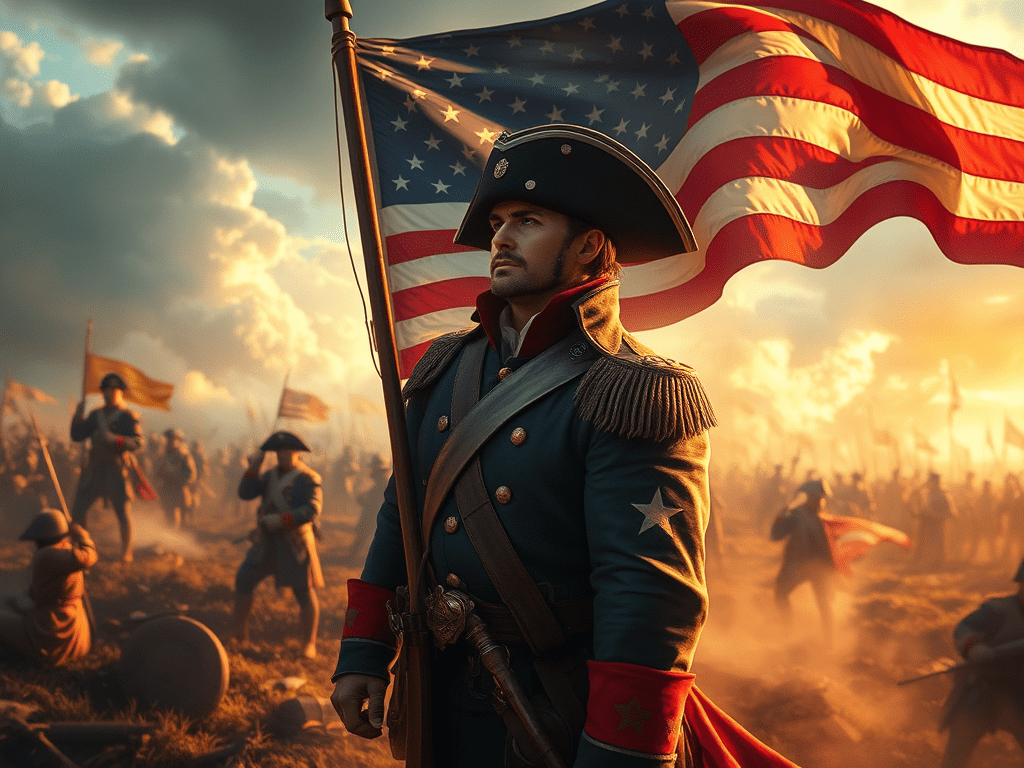
The critical takeaway here is that Americans love freedom so much that we violently rebelled against the British crown. Before the Continental Army was organized, militias were already on their way to rebel against the King. As descendants of the American Revolution, we should not only understand that our forefathers were rebels, but that they also accepted nothing short of reciprocity from the so-called King. They defended themselves against unlawful force, wrote and promoted ideas based on freedom, and continually fought for recognition of our independence.
Works Cited
https://www.britannica.com/event/American-Revolution/Washington-takes-command
 Words and Movements
Leave a comment